Understanding the factors that contribute to bacterial infection could help researchers develop new approaches to preventing serious infections in newborns.
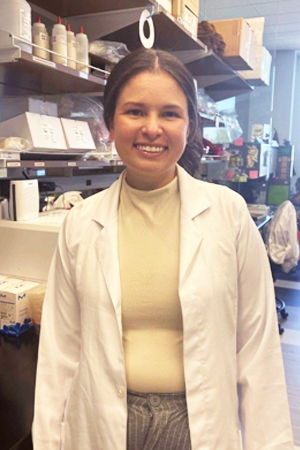
That’s the focus of Jessica Mendonca’s research as a postdoctoral researcher in the Department of Microbiology at the University of Tennessee. Mendonca also serves as co-chair of the university’s Postdoctoral Association.
Her research centers on Streptococcus agalactiae, an opportunistic pathogen that can colonize the vaginal and gastrointestinal tracts and is a leading cause of neonatal meningitis. Mendonca studies how this organism interacts with other microbial species, as well as how the body’s inflammatory response changes during bacterial colonization and infection.
For Mendonca, the work has a personal sense of purpose. Her commitment to disease prevention motivates her interest in understanding the factors that contribute to bacterial colonization and infection.
Mendonca pursued a postdoctoral position because she knew she wanted to remain in academia after completing her doctoral degree. She saw the postdoctoral experience as an opportunity to develop as an independent researcher while continuing to benefit from mentorship and guidance.
For those considering a postdoctoral opportunity, Mendonca emphasized the importance of building relationships and being willing to reach out.
Reach out to people, and don’t be scared to talk to them. Most of them are going to actually be very nice and super open to share ideas and talk to you.
Her experience at UT has also expanded her role beyond her own research. As a postdoc, Mendonca has strengthened her skills as a mentor, found opportunities to share her work and learn from colleagues, and become part of a growing postdoctoral community.
It’s a great university, it has great professors and great students. And being part of the community of postdocs here specifically, we see this community being built since the beginning.”
Mendonca’s work illustrates the role postdoctoral scholars play in advancing research that can have meaningful implications for human health. Through their research, mentorship and collaboration, postdocs contribute to the discoveries and knowledge that move their fields forward.
Learn more about National Postdoc Appreciation Week 2026 as UT celebrates 150 years of postdoctoral research in the United States. Explore opportunities to connect, learn, have some fun, and recognize the contributions of postdoctoral scholars across the university.